
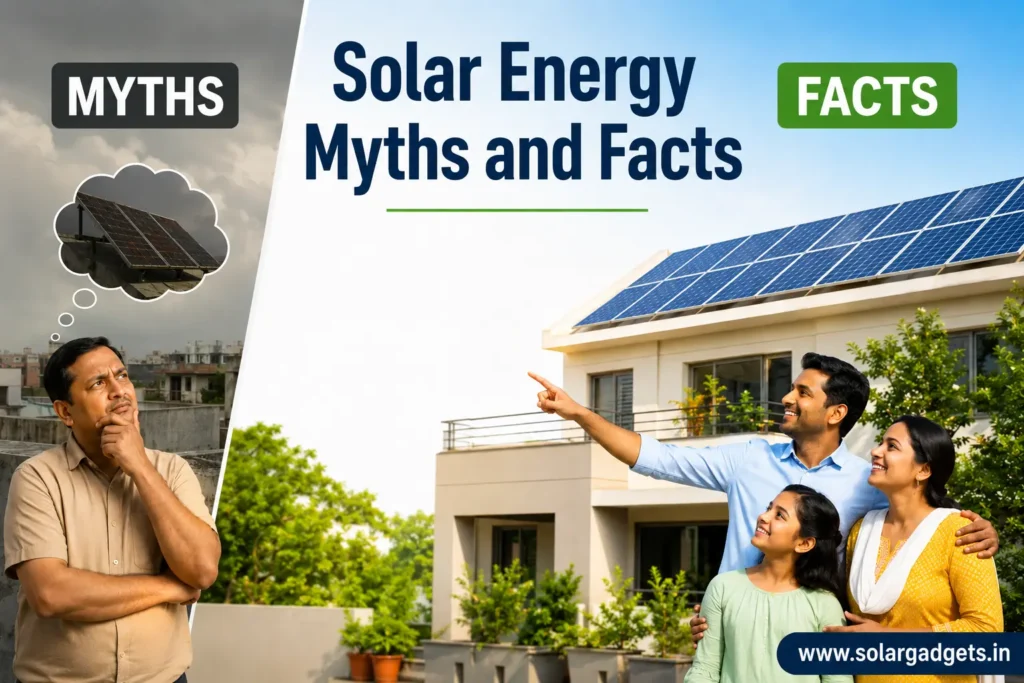
Solar energy is becoming one of the smartest home upgrades for Indian families, but many homeowners still believe outdated myths about cost, performance, maintenance, and reliability. In reality, rooftop solar has become more affordable and practical in India, especially with government support under the PM Surya Ghar: Muft Bijli Yojana and net metering benefits.
Table of Contents
Why Solar Is Growing in India
Rooftop solar is gaining attention because electricity bills are rising, households want backup power, and more people want to reduce dependence on the grid. For many homeowners, solar is no longer just an environmental choice. It is also a financial decision that can reduce monthly bills and improve long-term energy security.
Myth 1: Solar Panels Don’t Work in Cloudy or Rainy Weather
Fact: Solar panels generate electricity even on cloudy days.
This is one of the most common myths. Solar panels do not need perfect sunshine to generate electricity; they can still produce power from diffused sunlight on cloudy days.
The output may be lower than on bright sunny days, but it does not drop to zero. That means solar remains useful even during monsoon months or foggy winter days in parts of India.
Myth 2: Solar Installation Is Too Expensive
Fact: Solar is more affordable than ever due to subsidies and falling panel costs.
Many people still assume rooftop solar needs a very large investment. But the cost has become more manageable, especially because the Indian government supports residential rooftop solar through PM Surya Ghar: Muft Bijli Yojana.
The scheme is meant to make solar more accessible for households, and many homeowners can recover their investment over time through reduced electricity bills and net metering credits.
Myth 3: Solar Panels Require Constant Maintenance
Fact: Solar systems are low maintenance.
In practice, rooftop solar is generally low maintenance because panels have no moving parts and are built for outdoor use. Basic cleaning and occasional system checks are usually enough for most homes.
Also Read: Rooftop Solar Costs in India 2026: Complete Home Installation Price & Subsidy Guide
Myth 4: Solar Won’t Work During Power Cuts
Fact: This depends on the type of solar system you install.
A grid-connected system may shut down during an outage for safety reasons, while hybrid systems with batteries can continue supplying backup power.
That is why many Indian homeowners choose hybrid setups when backup is important. If your area experiences frequent outages, battery support can make solar much more useful.
Myth 5: Solar Panels Damage Your Roof
Fact: Proper installation actually protects your roof.
Panels act as a shield against direct sunlight, rain, and heat. Certified installers ensure no structural damage and often improve roof longevity.
Myth 6: Solar Panels Are Not Suitable for Small Homes
Fact: Solar is scalable for any home size.
Solar systems are scalable, which means they can be designed for homes of different sizes. A small house can still benefit from a smaller rooftop setup, while larger homes can install bigger systems if they have the space and power demand.
Myth 7: Solar Technology Is Not Efficient Enough
Fact: Efficiency has improved significantly.
Modern solar panels now offer 18–22% efficiency, making them far more effective than older models. With India’s abundant sunlight, efficiency is rarely a limiting factor.
Myth 8: Selling Excess Power Is Complicated
Fact: Net metering makes it simple.
Net metering sounds technical, but the idea is simple. When your solar system generates more power than your home is using, the extra electricity can flow back to the grid, and you may receive credit on your bill.
This is one of the biggest financial advantages of rooftop solar in India. It helps homeowners make better use of the electricity their system produces instead of wasting excess generation.
Myth 9: Solar Panels Have a Short Lifespan
Fact: Solar panels last 25+ years.
Panels commonly come with long performance warranties, and rooftop solar installations are designed to work for many years with limited upkeep.
Myth 10: Solar Installation Takes Too Much Time
Fact: Installation is quick and hassle-free.
The installation itself is usually not the longest part of the process. Once approvals, vendor selection, and scheduling are complete, physical installation can often be finished quickly.
The larger time factor is usually the documentation and approval workflow. That is why planning early helps homeowners avoid delays.
Final Thoughts
Understanding the truth behind solar myths is the first step toward making a smart energy decision. Solar power is no longer a luxury—it’s a practical, cost-saving, and future-ready solution for Indian homeowners.
If you are planning to install solar panels, now is the best time to act and take advantage of subsidies before policies change.