
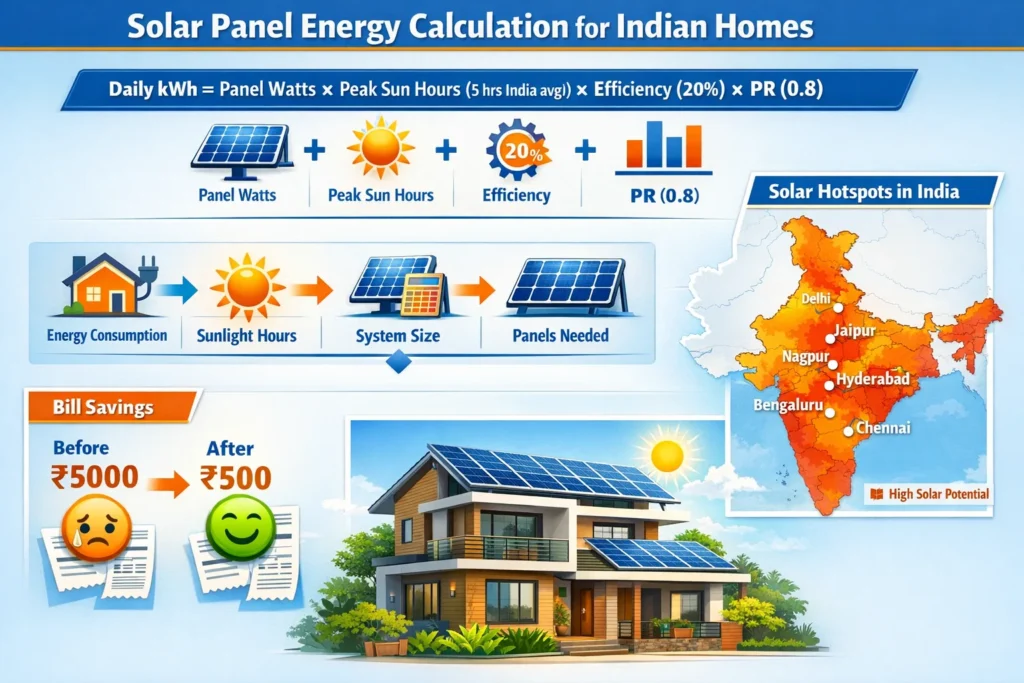
Calculating your solar energy needs is a straightforward process that helps homeowners and businesses size systems accurately for maximum savings and efficiency.
Table of Contents
Why Calculate Solar Energy?
Understanding your solar potential starts with assessing energy consumption and local sunlight. This ensures your system generates enough power without overspending. Proper calculations can cut electricity bills by 50-90% in sunny regions like Punjab, India.
Key Factors in Solar Energy Calculations for India
Several variables impact solar output, including location, panel efficiency, and roof space.
- Daily energy use (kWh): Review your electricity bills for average monthly consumption, then divide by 30.
- Peak sun hours: Expect 4.5-5.5 hours daily on average.
- Panel efficiency: Modern panels range from 15-22%.
- Performance ratio (PR): Typically 0.75-0.85, accounting for losses from heat, dirt, and inverter efficiency.
Solar Panel Output Formula for Indian Homes
Use this core equation for daily production:
Daily Output (kWh) = Panel Wattage (W) × Peak Sun Hours × Efficiency × PR
For example, a 300W panel with 5 sun hours, 20% efficiency (0.20), and 0.80 PR yields:
300 × 5 × 0.20 × 0.80 = 2.4 kWh per day.
Also Read: How Much Does a 5kW Rooftop Solar System Cost in 2026?
Step-by-Step Solar Panel Size Calculator for Indian Homes
Follow these steps to size your system precisely.
- Tally your consumption: Add up appliances’ wattage × daily hours used. Example: Fridge (150W × 24h) + AC (1,500W × 8h) = 15.6 kWh/day.
- Find local sun data: Use tools like PVWatts by NREL or MNRE Solar Rooftop Calculator for 5 peak hours.
- Account for efficiency: Divide needs by (sun hours × 0.80 PR). For 15.6 kWh: 15.6 / (5 × 0.80) ≈ 3.9 kW system.
- Select panels: Divide by panel wattage (e.g., 3.9 kW / 400W = ~10 panels). Check manufacturers like Waaree Energies or Saatvik Solar.
- Annual estimate: Multiply daily output by 365, adjusting for seasonal dips.
Best Free Solar Calculator Tools for India
Free online solar calculators make sizing effortless. Here’s a quick breakdown:
- PVWatts (NREL): Global tool for precise energy output based on address, tilt, and losses; ideal for custom simulations.
- Google Sunroof: Scans your roof via satellite for sunlight, savings, and installer matches; India-focused estimates.
- MNRE Calculator: Official Indian portal for subsidy-eligible sizing, costs, and PM Surya Ghar approvals.
Common Solar Calculation Mistakes to Avoid
- Ignoring shading from trees or buildings reduces panel efficiency by 20-30%.
- Overlooking inverter losses and other inefficiencies; always use a 75-85% performance ratio (PR).
- Skipping a professional site survey, which ensures accurate system sizing.
- Underestimating battery costs—they add 20-30% but enable off-grid power backup.
FAQs
How many solar panels do I need for a 2BHK home in Ludhiana?
For average 5-7 kWh daily use, you’ll need a 3-5 kW system (8-12 panels of 400W each), depending on peak sun hours of 4.5-5.5.
What is peak sun hours, and where do I find it for Punjab?
Peak sun hours measure effective sunlight (1 kW/m²). Ludhiana averages 5 hours/day; use PVWatts or MNRE tools for precise local data.
Does shading ruin my solar setup?
Yes, even partial shade from trees or nearby buildings can cut output by 20-50%. Trim trees or opt for microinverters during site surveys.
Are solar batteries worth the extra cost?
They add 20-30% to upfront costs but store excess power for nights or outages, ideal for Punjab’s summer peaks. Consider lithium-ion for longevity.
How much can I save on electricity bills?
A well-sized system can offset 70-100% of bills, saving ₹50,000-1,50,000 yearly in India, plus 30% MNRE subsidies. ROI in 4-6 years.
What subsidies are available for solar in India 2026?
MNRE offers ₹14,588-₹18,000 per kW for rooftops up to 3 kW via PM Surya Ghar scheme. Check MNRE portal for updates.